

Five (2022) Short Film Review
The fact that short films are forced to tell stories in a relatively limited period of time does not mean, stories shouldn’t be as structured as we’d expect them to be.
Take for example the recent gem we reviewed in the site: Hallelujah by Victor Gabriel. A very funny, yet sad, but ultimately compelling piece that did more for human values than most Hollywood films have done in recent times. Even if it doesn’t fulfill the expected formula, the twist is more than effective. It was emotionally engaging because it connected through a different channel.
Five, produced in the same environment as Hallelujah, is a very different film. One that’s more grounded and set under the weight of a tragedy that strikes in a different organ of a family. But the structure is just innovative. And it’s what makes Five a completely different film from the ones we’re used to seeing. Yes, even feature length films.
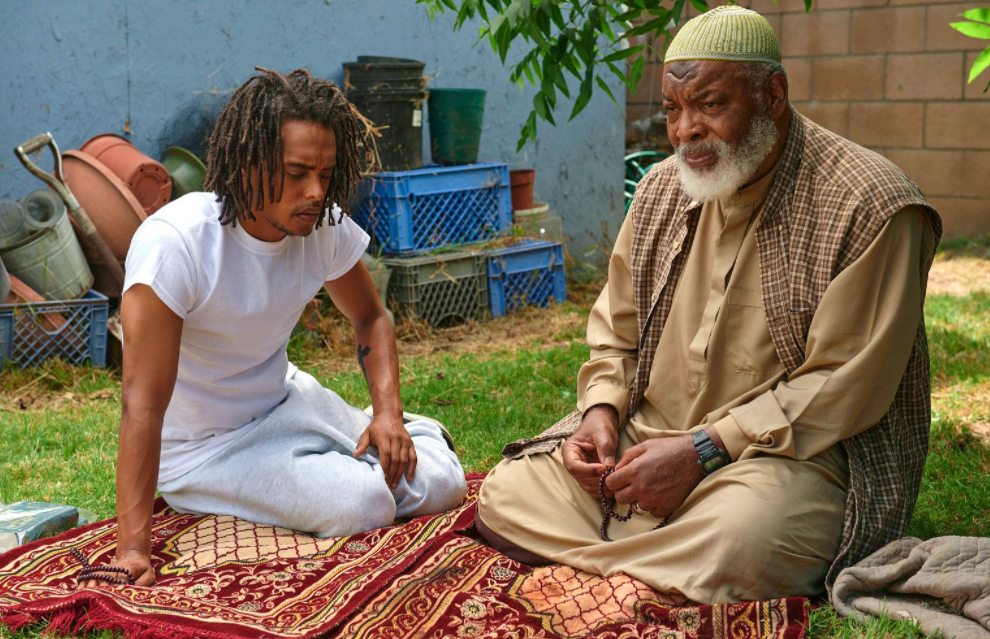
In Five, a young man by the name of Malcolm is released from prison. Years ago, when he was just a teenager he was convicted of a very serious crime. The emotional scar is there in his silent gaze. Malcolm has found Islam, and now lives by the rules of the religion, praying five times a day and repenting from his past.
However, his home isn’t what it used to be. His mother has abandoned every chance of forgiveness and communicates with her son with cold, messy notes. Malcolm is unemployed and hopeless. Only a fellow ex-convict seems to understand his circumstance and reality. When Malcolm has an encounter with his past, he comes to face the emotional burden he’s almost afraid of. Finding redemption is far from possible in the streets where he grew up and turned into the monster his mother thinks he is.
Jacob Romero Gibson plays Malcolm in a very precise performance that’s far from representing a safe zone for the actor. He must play Malcolm in his two “lives” and the actor manages to tell the story through a physical expression that’s admirable. With him J.D. Hall and Hilary Ward, play the balance in the story. The set of adulthood that Malcolm has to digest for becoming his own version of a grown, forgiven man. But first of all, he has to forgive himself. And that he doesn’t seem to do.
It’s where Duran Jones’ script feels like a pin that doesn’t let the story wander in the possibilities of excessive drama. Jones sets his focus on Malcolm’s persona and the need for acceptance. However, a natural reaction drives us to judge. In that mistaken impression we, the audience, feel it’s fair for Malcolm to suffer for his sins. Jones makes Malcolm a silent entity that’s already suffered enough and just needs to move forward. Even if his crime wasn’t intentional, it’s still a crime. One that he definitely paid for. With this hopeful consideration, we continue with Malcolm.
For some, religion means hope, the opportunity to move forward. For an ex-convict it could be a safe space where they can dig deep until they can find redemption for themselves. But Malcolm is far from being a renovated man, his burden is just too heavy. In this middle ground, where some see monsters, and others see men, we can locate Five.
David Orantes leads the orchestra with a sensitivity that’s simply important in today’s independent cinema. These are young artists trying to express and they accomplish so in a profound way. One just wonders what they can do if these shorts are turned into feature-length films. In that train of thought lies the hope of being able to witness original views that in today’s loud world of cinema, feel like the relevant connections to more emotional filmgoers.


