

Hallelujah (2022) Short Film Review
Some films, and filmmaking styles, are known for being direct and obvious cautionary tales about a reality not everyone is familiar with. From a critic’s point of view, I try to dive into worlds that I’m perhaps not familiar with, but are widely known enough to raise some kind of awareness. One of these environments where these films take place is that of gang violence, and gang culture. Most of the time, two hours seem enough to go deep and understand a system, and come up with a few questions about it.
However, sometimes films transcend. They are revealing (without necessarily being realistic) about the real issues. The short film Hallelujah is one of these. With less than fifteen minutes, the story is told from the perspective of snappy characters that are forced to live through their own personal version of hell. But what comes after it? Is there actually something?
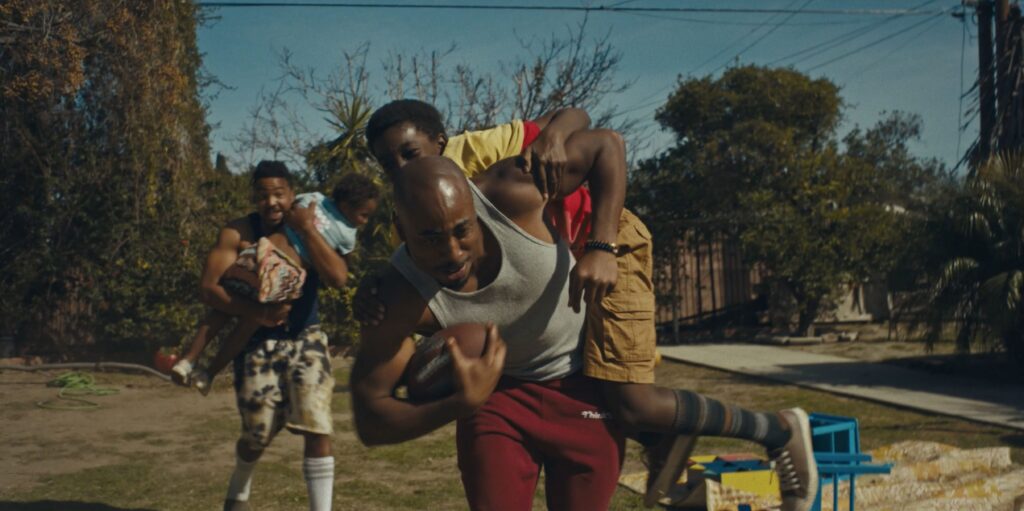
In Hallelujah, two brothers are chilling in their backyard in Compton, CA. A girl is playing. A boy dressed in strange clothing is mumbling about books and existential subjects. They’re not impressed to say the least. But then the boy decides to try to commit suicide and fails. Alarmed as they get, they notice the boy has a strange fascination with suicide and death. When the boy and the girl decide to leave the house, the two men go after them. They will all encounter the reason behind the boy’s bizarre thoughts.
Victor Gabriel writes and directs Hallelujah with one thing in mind. Trying to make sense of the consequence of something as horrific and random as gang violence. It’s not that he accepts violence as something regular in the community he grew up in. It’s that he attempts to comment on the cynical normalization of tragedies like these. And his comment, as sharp as it may be, it’s also full of a strange kind of hope that blooms in the weirdest and most human of places: a family being born of a tragedy.
It’s hard not to think of John Singleton’s style for setting up scenes, and Spike Lee’s body of work during the film’s pivotal scene. A continuous shot in which characters are established and introduced in a clever way considering the narrative of the short film format. Tragedy strikes when you least expect it to (and on whom you least expect it to). Facts become reasons, and then become a theme for the Hallelujah.
Regardless of what you read above, Hallelujah isn’t a harrowing short film. Sure, it’s tragic. But it isn’t a sad statement. It’s a moving portrayal of unconditional love and realization about something that’s weirdly become predictable for circles in which crime still reigns. It even reigns as a lifestyle for some.
I may be giving away too much, but the humor element of the films helps the viewer understand this isn’t a regular and reiterative message. A voice-over during the whole film resembles comedy, but I can’t assure you it’s not. Stellar performances by Bruce Lemon, Richard Nevels, Stephen Laroy Thomas and Mariah Pharms, are enough for the film to stay with you for a while. All this combined with an impressive cinematography, makes the short film Hallelujah a beautiful rendering of an idea that hasn’t been talked about sufficiently: Love grows like weeds in the most unnatural and unacceptable places.
An impressive short film by a newcomer whose work I definitely want to see more of.


