Vintage Movie Review: Grosse Pointe Blank
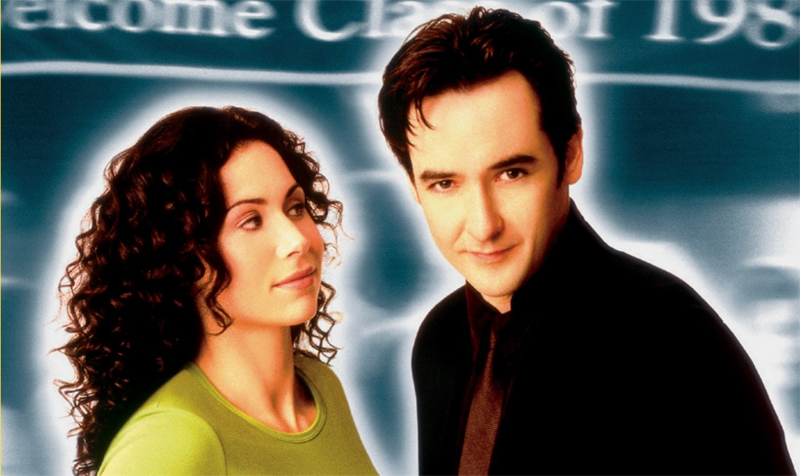
Minnie Driver and John Cusack in Grosse Pointe Blank.
The real reason I stayed sane last semester was the existence of John Cusack. Yes, you read that correctly. Whenever I got overwhelmed with schoolwork, exams, friend and family crises, and break-ups, I’d pop in The Sure Thing, Say Anything or another one of my countless favorite movies of his and all of my troubles would disappear.
I always knew that Cusack was brilliant and that his true talent would ultimately shine. That’s why I wasn’t surprised when he reunited with his old high school buddies, Steve Pink, D. V. DeVincentis, and Tom Jankiewicz to write Grosse Pointe Blank’s wickedly hilarious screenplay, dripping with brutally dark sarcasm.
The plot is far-fetched and, therefore, requires the viewer to have a huge amount of a willing suspension of disbelief in order to appreciate it. Professional hitman, Martin Blank (Cusack), wants to go straight and be reunited with his long-lost high school sweetheart, Debi (Minnie Driver), who he stood up ten years ago on prom night. In order to do this, he has to jump through quite a few hoops, including battling his psychotic, gun-toting adversary (Dan Aykroyd) and attending his and Debi’s high school reunion while he is in town, finishing the last assignment of his career.
So what went wrong? What happened in his life that caused him to be a hitman? The movie takes all the right steps in touching on the answer. For example, he visits his mother in the loony bin and she doesn’t even remember her own son’s name. Later, he pours what appears to be a bottle of whiskey on his dad’s grave in remembrance of his deceased father.
The chemistry between the two leads is explosive. Enjoying a hot and heavy love affair during the making of the movie definitely helped Driver and Cusack. Their characters balance each other out perfectly. Debi has a childlike innocence. She loves View-Masters and playing airplane. Martin has lost most of his innocence in traumatic experiences that have made him view life in a cynical, yet humorous way. Martin looks to Debi to help wipe away that gritty film of pessimism and Debi looks to Martin for maturity.
When they meet for the first time in ten years, they realize that neither one of them has changed. Debi is still very bitter about Martin abandoning her. How bitter? When he picks her up for the reunion and hands her a bouquet of red roses, she smiles dryly and says, “I’ll be right back. I’m going to put these in some rubbing alcohol.” Martin still has his witty sarcasm: “How could I possibly tell someone at the reunion what I’ve been doing for the past ten years? Oh, you have a great husband and adorable kids? That’s excellent! Oh, me? Well, I killed the president of Paraguay with a fork.”
It’s not often that we get to see movies in which the main character undergoes a radical transformation. In one key scene, a bully from high school belittles Martin. Instead of beating him to a pulp, Martin uses a little reverse psychology: “What makes you think that there is some stored-up conflict between the both of us? There is no us. It’s not me you want to hit. Who do you want to hit, man?” Little does he know that Debi is watching all of this. ‘Yes,’ she muses, smiling in admiration. ‘He can be mended.’ “Either that kid is in love with the girl or he has a newfound respect for life,” Martin’s adversary comments. Well, it’s a little bit of both. Here is a hitman coming clean and having the opportunity to get a second shot.
This article originally appeared in the November 20, 1997 edition of Towson University’s newspaper, The Towerlight. I would like to think that I’ve become a better writer since then and am more well-rested than I was in my college days. I would also like to think that the same thing can be said for my editor at the time. So I’ve made some necessary revisions.