

Sanzaru (2020): Movie Review

“There’s something wrong with this place.”
There absolutely is something wrong with the home that we spend most of our time inhabiting in Xia Magnus’ Sanzaru (2020), although it takes most of the movie’s runtime to reveal what it is. The film’s slow pace might be off-putting to some viewers, but there are chilling moments peppered often enough throughout the plot to cement its dark mood. By the end of the film, a secret is unveiled that casts a disturbing shadow over the rest of the story, and is satisfying in its own subdued way.
Sanzaru follows Evelyn (Aina Dumlao), an in-home health aide that helps look after an elderly dementia patient, Dena (Jayne Taini). Dena often exhibits mental clarity – helping Evelyn with the crossword – but does occasionally make remarks that have disturbing implications: “They’re inside of me. I can feel them.”
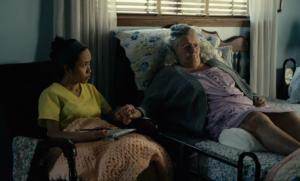
The movie is not about Dena, though; it is about Evelyn grappling with her own sanity while assisting Dena with her mental and physical decline. Unfortunately, moments where we see Evelyn’s question her mental state are barely concrete enough to be confidently identified, and are so rare that any frightening tone the movie could hope to sustain falls off almost immediately after it appears. At least, that is the case for the first two-thirds of the movie, where most of the plot involves Evelyn dealing with family drama, doing laundry and making romantic advances that come out of nowhere. Occasionally she does hear a voice coming through the home intercom system, seemingly coming from Dena’s room. This voice speaks Evelyn’s native language, and addresses someone named “Mr. Sanzaru.”
The sheer lack of information the audience receives about Mr. Sanzaru makes this film feel like a mystery, but one that none of the characters seem particularly motivated to solve. This fact gives the story a meandering feel that isn’t particularly conducive to a thrilling experience. The music and camera movements do a lot to create genuinely scary scenes, but the fact remains that the audience may be at a loss to exactly what they are supposed to be afraid of! Undeniably, the film is well edited: the sparse use of soundtrack and lingering shots emphasize suspenseful moments that may not have stood out in the script.
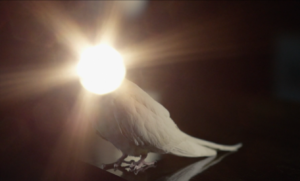
I liked the minimalism that this movie expresses: it feels appropriate for a psychological thriller. Little things that go wrong – a pet bird dying, milk spilling – turn into earth-shattering events for Evelyn. A letter addressed to Mr. Sanzaru appears in the family’s mail, a “mistake” that Evelyn fixates on, although the plot does not give any characters’ fixations much attention. Like everything else in this film, any interiority we might hope to see from the main character is hopelessly subtle, sometimes to a fault.
The uneven character development might be this film’s biggest downfall. For its length – 87 minutes – and form – slow, psychological thriller – a clearer focus on Eveyln may have given more substance to a plot that, at its worst, felt directionless. Instead, she is hard to read and her background is almost completely unknown. When pieces of information are finally revealed about the main characters: Evelyn, and Dena’s son, Clem (Justin Arnold), they feel like digressions rather than illuminations. The premise of the film – a home aid questions her sanity – demands a story that is character-driven. If that was the aim, it was not successful.
Luckily, a character-driven psychological thriller was not this movie’s sole aspiration. It is, more importantly, a successful ghost story. Throughout the film, we hear a female voice that addresses Mr. Sanzaru, and occasionally we see human figures composed of red light walking throughout the house. These scenes were my favorite parts: the effects are minimal and stylish. Due to the sparsity of scares throughout the film, understated moments of supernatural suggestion work beautifully. And, the mystery that the story revolves around – who is Mr. Sanzaru? – plays out really interestingly through both the ongoing ghostly conversation and interactions between Evelyn and Clem. The end result is appropriately chilling, justifying the slow build-up.
Sanzaru is not without its pitfalls (mostly missed opportunities for character development), but is a worthy entry in the genre of subtler horror films. I was very impressed with the composition of shots as well as the music, which contributed tension where there otherwise might not have been any. I consider this a well-directed debut from Xia Magnus that shows a unique vision and style. It is always refreshing to see horror movies that aren’t trying to make you jump out of your seat, but still want to disturb your sleep. This is one of those films.


I love watching horror movies, independent films, foreign films and the occasional sleazy exploitation dive.
