

Machination (2022) Film Review
With a running time of approximately 1 hour, anyone would think that Sarah Jayne Portelli and Ivan Malekin‘s Machination would be edited with only the important elements of the story in mind. Secondary aspects would be kept on an undisclosed guessing plane in this little indie film. We are not used to anything other than extremely careful use of footage, which tends to play a bit with the vision of whoever is designing the story.
However, in a rather long opening sequence, the “shift” matters. In fact, without that scene the connection that a film like Machination needs would feel forced.
In that sequence, a young woman becomes a reflection of our lives over the past few years. The simplicity of her movements, the subtlety of her new habit, and the dormant paranoia are signs of her future. But I insist, those who direct do not skimp on demonstrating that the screen is a mirror. And what is going to happen is a version of what could have happened to all of us. I would dare say that it happened to some of us. Yes, we were victims of a system that required our attention and we were careful because it served us well. However, the limits were never exposed because few cared. Those boundaries are the central theme of Machination, a short adaptation of a time in our history when we were dominated by a legend that yes, there was some truth to it, but not everything was as it was shown.
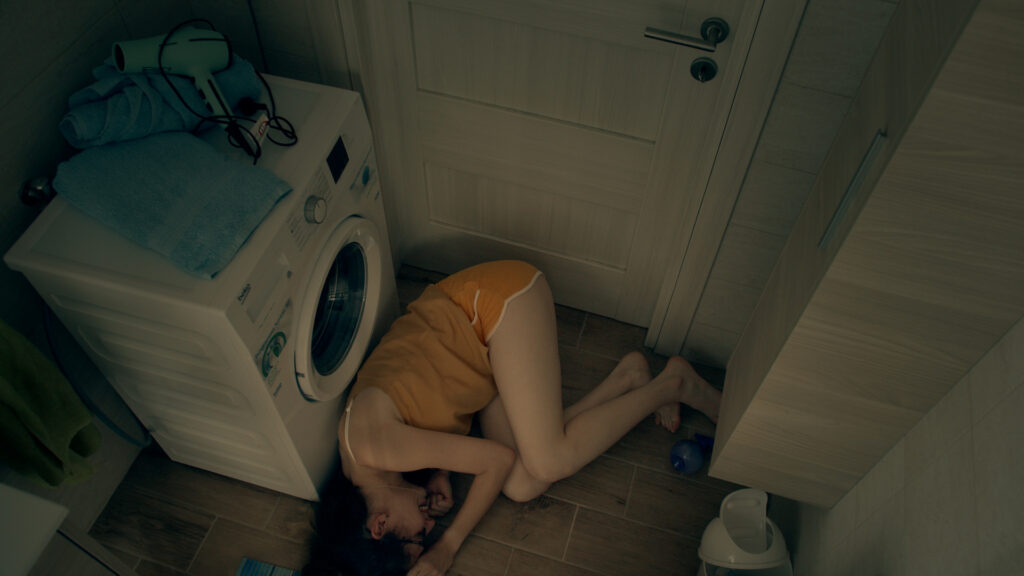
Maria is a young woman living alone in a house during the beginnings of a pandemic due to a disease that no one understands. She submits herself to “extreme care” according to those she reads and the news she watches. Maria’s routine is extreme. Between gloves and disinfectant fluid, Maria spends her days trying not to get sick.
When she begins to have symptoms of a cold, the young woman decides to isolate herself. Her anxiety exceeds the limits of normality that isolation has formed around her and her contact with the outside world. Maria decides not to go to work, nor to see her relatives in the hospital.
Between paranoia and symptoms, Maria withdraws into herself. She becomes a victim of something apparently invisible. But after a while, Maria begins to see that there is “something out there”. And that something doesn’t stop until it enters the poor young woman’s house.
Machination is a show performed by its protagonist. Maria is played by Steffi Thake, and the actress’ delivery is absolutely fierce. Rarely does indie cinema display this kind of performance in which the drama is based on something much more organic and passive than whatever emotional diatribe the story brings. Maria is a common element of the milieu, and Thake never uses the denouement to her advantage. The actress is driven by the confidence she feels in the story her directors have planned.
And what a story it is. In Machination, the worst thing we came to imagine that could happen to us doesn’t end up happening. But the conclusion for Maria is a terrible possibility that we never saw, even though the hint was always there, latent and dangerous. The hint of something worse that would affect us irreversibly.
An approach of psychological horro,r but framed in the drama that we all live, Machination is a sober vision of a horrible moment that we have already been able to overcome for the most part, but of which there are still traces. It’s not about going against science. It’s about maintaining the mental stability that science has provided as it progresses. That opening sequence in Machination speaks volumes about us and what we did. It paints a stark version of what we forced many to do. And the film shows, in a tragic way, how weak we sometimes are when it comes to facing our reality.
This is one of those movies that everyone should see.


