From the Movie Review Vaults: The Object of My Affection
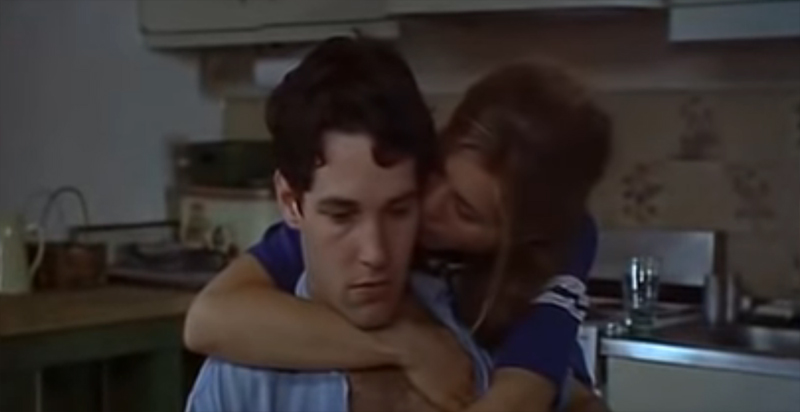
Paul Rudd and Jennifer Aniston in The Object of My Affection.
Okay, the plot is ridiculous: A woman comes to the stunning realization that her fiance is a jerk, and that she would much rather have her roommate father the baby she is carrying. The plan is oh-so-convenient since she’s in love with him. But here’s the catch: He’s gay. Will he or will he not be able to transform himself into a heterosexual male who loves her back?
Jennifer Aniston and Paul Rudd are taking a real chance. Fortunately, these two showstoppers don’t miss a beat in this flawed but delightful romantic comedy. As Nina’s best friend, George, Paul Rudd is just as endearing here as he was in Clueless as Cher’s (Alicia Silverstone) stepbrother, Josh. He has an approachable, awkward air. Jennifer Aniston is also impressive as the spunky, witty, and intelligent Nina.
The chemistry between Aniston and Rudd is exquisite. Because sex doesn’t play a part in their relationship, they share something much more profound and intimate–best friendship. They’re comfortable enough to act silly with one another, pillow fighting and play wrestling in their plaid flannel jammies.
Most of the supporting cast is wonderful. Alan Alda is hilarious as Nina’s stepsister’s husband, Sidney. His witty neuroticism and sarcasm enlivens the dialogue. Steve Zahn is also amusing as George’s womanizing brother who goes through fiancees as frequently as he changes his socks. “Really? That’s news to me,” he replies after George tells him that he can get close to a woman without sleeping with her.
The real standout performance of the supporting cast comes from Nigel Hawthorne, who plays George’s lover’s mentor. He is a scream, especially when he claims that a modernized stage version of Romeo and Juliet is nothing but a series of Calvin Klein ads and that the director should be shot.
The Object of My Affection does have several major flaws. The film begins beautifully, but it digresses into a slew of silly, unnecessary, and insignificant subplots. The first finds George visiting his ex-lover, who wants to get back together. Because of his past betrayal, George lets him know that his trust will not be easy to win back. In the second digression, George ditches him and falls in love with another guy. The dynamics of George’s relationship with his new lover are not explored in enough detail to be convincing.
Despite these objections, the viewer can’t help but smile at the realistic, uncompromising ending. Sure, unrequited love is heartbreaking, but true best friends value their relationship enough to know that honesty, in the long run, is always the best policy.
This article originally appeared in the April 30, 1998 edition of Towson University’s newspaper, The Towerlight. Since then, I would like to think that I’ve come a long way in my writing and I think that the same thing can be said for my editor at the time. So I’ve made some necessary revisions.