

The Death of Star Trek

Fear…..the final frontier. I had a very harrowing epiphany recently after seeing the premiere of the latest installment of my all time favorite franchise- Star Trek:Beyond. The movie was amazing but because of my realization, I’m not able to enjoy it with the same hope and optimism that Trek had previously bestowed upon me. I can now not only predict, but calculate the exact date that Star Trek and worse yet, all hope for humanity, may end: April 5th, 2063. If I live to be 86, I will watch that day come and go with sorrow, and certainly my children will live to see it. The gravity of our current situation is extremely dire, Captain.
First, let me tell you what keeps me watching the voyages of the Starship Enterprise, and what really separates Star Trek from any other science fiction story I can think of. In brash opposition to the apocalyptic and dark predictions of the future brought to us by Wells’ The Time Machine, Kubrick’s A Clockwork Orange, and for relevance sake, even The Walking Dead or Mad Max, Trek creator Gene Roddenberry imagines an Earth that has escaped its own self destruction, overcome its fear and prejudice of other races, and abandoned its lust for personal wealth. John Lennon would approve wholeheartedly.
When the TV series first aired in the late 60’s, we joined Captain Kirk and his loyal crew, in the Earth year 2265. The crew was comprised of an Iowan first in command, a Russian tactical officer, an African female linguist, a Japanese helmsman, a Scottish engineer, and a non human science officer with pointy ears. Imagine, if you can. That was an edgy concept for a decade that had endured so much civil unrest and racial tension. The people of Kirk’s earth were not divided by borders or race, but united in a mission of peaceful exploration and search for knowledge. That’s a hell of an idea and maybe the only answer for our survival here in the real world.
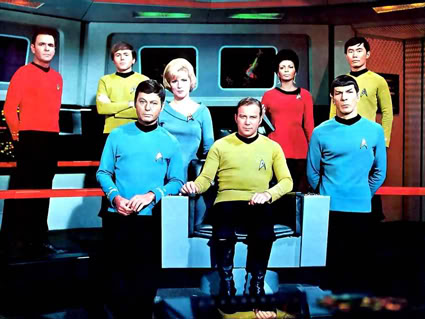
Roddenberry wrote backstory to corroborate the evolution of his Earth and subsequent writers expanded and clarified that timeline, creating a history that connected our own reality to that of Kirk’s United Federation of Planets and beyond. Without going total “fanboy”on you, the story goes something like this: in the early 21st century, humanity faced numerous calamities. Genetic engineering gone awry, destructive territorial wars, disease, greed, global hunger, over consumption of limited resources and poverty brought us to the brink of extinction. Sound eerily familiar? Sometime around 2050, Earth was devastated by nuclear war, decimating the population and driving the remaining patches of humanity to scatter and fight for basic survival. It didn’t look good for us then, or doesn’t now, I should say. Our reluctant savior and messiah came in the form of an eccentric, reclusive astrophysicist and engineer named Zefram Cochrane. Cochrane took the shell of an abandoned Titan II nuclear missile, and from a silo in Bozeman, Montana, built the prototype of his own “warp-drive” technology, an engine capable of exceeding the speed of light and enabling future generations to boldly go where no one has gone before.
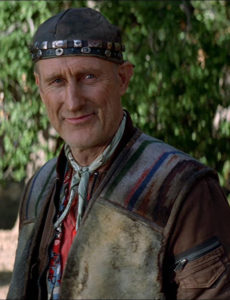
In a fortuitous twist, his first flight at warp speed on April 5th, 2063 was observed by an alien ship passing through our solar system. The aliens were intrigued by our technological feat and deemed us worthy of “first contact”. They proved to be a logic driven, peaceful race of humanoids called Vulcans, and our path to the future had begun with our new pointy eared friends to guide us. Cochrane’s character first appeared in a 1967 episode of the original series, but was immortalized by brilliant actor, James Cromwell, in the feature film Star Trek: First Contact. Then it hit me-2063 is only 47 years from now. Time to issue a red alert and reroute all power to the deflector shield.
The realization left me discouraged, afraid, confused, and yet trying to maintain a morsel of hope for my fellow humans. The future is never written in stone and no destiny is unchangeable, but clearly we aren’t ready to move into a bold new world where our people unite through a common goal of brotherhood, community, love and the quest for collective understanding. We may still fulfill Star Trek’s prediction of global nuclear war by 2050, but our chances of pulling off a rise from our own ashes as Zefram Cochrane did seem bleak at best. (Cochrane’s first warp rocket was poetically named The Phoenix.)
In the 1960’s, when Gene Roddenberry first launched his groundbreaking series, the world was still a scary place, embroiled in the Cold War, burdened with the fear of nuclear first strike and as racially divided as it is today. The shining ray of hope back then was NASA, it’s triumphant Apollo missions, and the first man to walk on the moon. It seemed as though we may rescue ourselves from internal defeat, to look to the stars, and explore the universe together. In the 1980’s the space shuttle program inspired us (one was even named Enterprise) by sending ordinary people and scientists, not just pilots into orbit, and in the 1990’s we saw the construction and launch of the International Space Station, a collaboration between longtime enemies, the Federation and the Klingons, er-I mean, the Americans and Soviets. We had ended the cold war, lessened the impending fear of nuclear holocaust and partnered with our rivals for a mutually beneficial endeavor of discovery and wonder. It seemed as though we were headed in Roddenberry’s direction, so what happened?
I don’t pretend to possess the answer of exactly how we got from there to here, but as the 2063 date approaches, there are hard facts to support the theory that we’ve stumbled off course, and have little time left to correct it. A combination of economic recession and a shameful lack of public support to fund NASA led to a dramatic reduction in the budget for our space program, and worse yet a shift to privatize space travel in general. Instead of diving headfirst into bold new reaches of the solar system, companies like SpaceX are now using the prospect of private and luxury space travel for the wealthiest elite, and even the ambition to use space technology for mining asteroids, extracting precious minerals and of course……making a fat profit. I’m not sure Captain Kirk could be as persuasive and influential a galactic ambassador if he merely represented his corporation’s board of directors. Imagine his crew’s five year mission-to explore potential economic growth, to seek out new resources and new financial markets to exploit, to boldly go where no investor has gone before. Does that seem right to you?
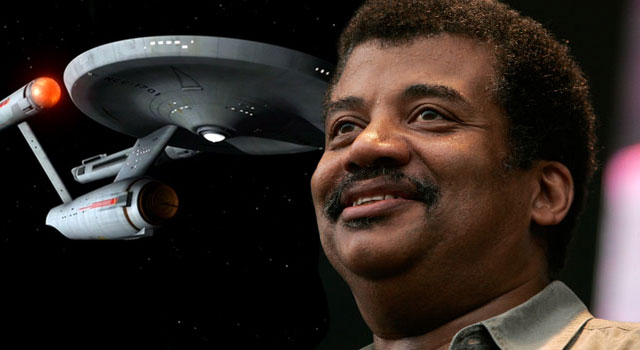
During the same time that NASA had been rendered obsolete, US defense spending has risen dramatically. Since the events of 9/11, and the wars in Iraq and Afghanistan, our discretionary military budget grew to almost 600 billion dollars in 2015, not including veterans benefits. Can’t our boys at The Pentagon throw Neil Armstrong’s legacy a bone? NASA received 18 billion in 2015, exactly 3% of what the military got. Famed physicist and Trekkie, Neil DeGrasse-Tyson testified at a 2012 meeting of the US Senate Science committee that, “Right now, NASA’s annual budget is half a penny on your tax dollar. For twice that—a penny on a dollar—we can transform the country from a sullen, dispirited nation, weary of economic struggle, to one where it has reclaimed its 20th century birthright to dream of tomorrow.” That’s what I’m talking about, and I dare you to find a brilliant theoretical physicist who doesn’t love Trek. One of my heroes, renowned thinker Stephen Hawking, made a memorable appearance in an episode of Star Trek: The Next Generation. How cool is that? I guarantee Dr. Hawking wouldn’t agree to a cameo on The Voice.
Unfortunately, as is despairingly evident in this year’s Republican presidential nominee and party platform, we’ve transformed from a nation that once led the world in human rights and equality, in our journey to the moon, that once proudly proclaimed on our Statue of Liberty, “Give me your tired, your poor, Your huddled masses yearning to breathe free, The wretched refuse of your teeming shore”, into a conflicted, xenophobic and under educated population threatening to build massive walls, to dictate freedom of choice and to deport millions of undesirable human refugees. That same nominee, let’s call him “Khan” for now, is calling for a more aggressive, even larger defense budget, and an America that would cease to build global partnerships in exchange for hard line, unilateral domination. His loyal followers are feverishly supporting his cause, chanting a very scary, nationalistic and brutal version of Lady Liberty’s forgotten mantra, poorly translated as only–“USA! USA! USA!”. A predictably rash and emotional human response, Doctor McCoy….but highly illogical.

I am only one person, one small part of our family here on Earth, and cannot make change without total human cooperation and devotion, so today I am sad. I don’t want us to reach the brink of annihilation before we choose a peaceful path because by then it may be too late. I want us to join hands, to be inspired by the explorers, thinkers and peacemakers that came before us, to look to the stars, imagine the Utopia of Roddenberry’s vision, to live long, and to prosper. I pray we can avoid global extinction, and sadly await 04/05/2063, hoping the Vulcans will show us the light. Kirk out.


'Well, uh, for Paulie, I really want to get him a snow cone machine. You like snow cones, don'tcha?'- Rocky Balboa
