

Benjamin’s Stash
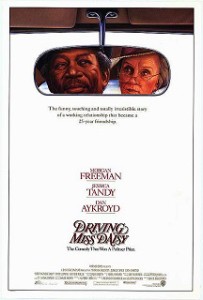 In 1948, Daisy Werthan (Jessica Tandy) is a wealthy, 72-year-old, widowed, retired school teacher who lives in Atlanta, Georgia. Except for her housemaid Idella (Esther Rolle), she lives all alone, which worries her son Boolie (Dan Aykroyd) after she wrecks her car trying to back out of her driveway. Following that accident, Boolie puts his foot down and hires Hoke Colburn (Morgan Freeman) to serve as her chauffeur.
At first, Daisy resents the idea of being chauffeured around by Hoke, and Boolie even warns him that his mother is a little “high-strung”, but over the course of time, the two strong-willed people gradually learn to accept one another.
Based on Alfred Uhry’s play of the same name (Uhry also wrote the screenplay, for which he’d win the Oscar for Best Adapted Screenplay), Driving Miss Daisy isn’t in any way like the sweeping epics we’ve seen storm the Oscars and claim the top prize – Gone With the Wind, Casablanca, Ben-Hur, The Godfather, The Lord of the Rings: The Return of the King, etc. No, far from it, Driving Miss Daisy is a much smaller film, though by no means small in regard to the story’s time span, that bears no shame in embracing the fact that its cinematic comfort food, yet it’s so pleasantly paced and beautifully acted that it rises above being the schmaltzy slice of cringe-inducing quaintness it could’ve been.
It’s unfortunate that for whatever reason, this film has garnered a strong disliking from some, though even back when it was first released, many people were critical of the Morgan Freeman’s portrayal of Hoke Colburn. I’m sure his “yessir”, “yes ma’am” uppity attitude was like nails on a chalkboard to the much more open-minded Spike Lee, who spoke ill of this film back when it first came out and continues to do so this very day. Perhaps it’s not so much the portrayal of Hoke as it is the fact that Driving Miss Daisy took home four Oscars, including Best Picture, and his film, Do the Right Thing, went home empty handed.
In fairness, Do the Right Thing is the better film, but Lee’s criticisms, among others, seem to be completely ignorant of the fact that Driving Miss Daisy is supposed to reflect the time and place of the story – 1940-60’s Georgia. I guess that’s expected, though, when your head’s been up your ass that long.
Three of Australian director Bruce Beresford’s best films have taken place in the American South. Driving Miss Daisy is one of them; the other two are Tender Mercies and Crimes of the Heart. Beresford’s sensibilities seem to fit the region like a glove, and here he captures a look and feel of the mid-20th century South that’s idyllic yet also aware of the era’s problems (Hoke is often the victim of prejudice, and Daisy experiences it herself after her synagogue is burned down). Spanning the course of a quarter-century, Beresford exquisitely paces Hoke and Daisy’s journey together, allowing their relationship to develop naturally from the initial stubborn battle of wills to their touching final scene together.
Though Beresford’s understated touch should by no means go unnoticed, Driving Miss Daisy wouldn’t be as great as it is if not for the excellent performances from Jessica Tandy and Morgan Freeman, the former a stage star whose resume dated all the way back to the ’30s and the latter an actor whose career was just getting warmed up.
Both Freeman and Tandy provide great care in turning Uhry’s characters into fully realized human beings. Despite what Spike Lee thinks, there’s more to Hoke than just the kindly old black man, and likewise, Daisy is more than just the crotchety old Southern lady. She’s prickly and prideful; God forbid this dead ringer for my late Grandma Ray actually have someone help her out when she feels perfectly capable of doing it herself. But then there are these subtler moments that reveal within Daisy a softer side, and as age takes its toll on her toward the end, her arc turns heartbreaking. As she ages a quarter-century, Tandy’s required to handle a wide range of emotions and personality changes, and there’s not a false note to be found in her complete performance.
Driving Miss Daisy wasn’t Morgan Freeman’s breakthrough; in fact, his frightening performance as Fast Black in the criminally underrated Street Smart had already earned him an Oscar nomination for Best Supporting Actor. But it was this film, however, that finally made him a bona fide movie star. In between both those films, Freeman had roles as the bullheaded principal in Lean on Me and the gravedigger John Rawlins in Glory. All four roles are vastly different from the other, and serve as proof of Freeman’s immense versatility.
As Hoke, Freeman transcends the subservient “shuck and jive” caricature critics of this film see him as. He’s gentle and has the patience of a saint (you kinda have to and then some to drive that crazy bat around), but he also carries with him a witty sense of humor and the confidence to call out Daisy on her ignorance when she’s seems unable to make any connection between the prejudiced attacks she and Hoke receive.
With all the attention Tandy and Freeman deservedly receive, it’s easy to forget just how good Dan Aykroyd is as Daisy’s son Boolie, a performance that would earn him his first and only Oscar nod for Best Supporting Actor. Given his work in mainly comedy – Saturday Night Live, The Blues Brothers, Trading Places, Ghostbusters – Aykroyd might seem like a surprising casting choice to some, but the natural born Canadian is all charm and pulls off an effective Southern cadence that helps him to slip into the role.
Driving Miss Daisy may not seem like much compared to other, grander Best Picture winners, but Bruce Beresford and Alfred Uhry have crafted a simple yet heartfelt picture that nicely balances its genuine sweetness with sharp wit. On top of that, and the main reason this film doesn’t flounder in a giant pool of saccharine mush, you have two terrific showcase performances from Jessica Tandy and Morgan Freeman – the crowning achievement of one star and the emergence of another.
Review source: http://silverscreenfanatic.com/2016/01/19/benjamins-stash-107/


