An Interview With Richard Ashrowan
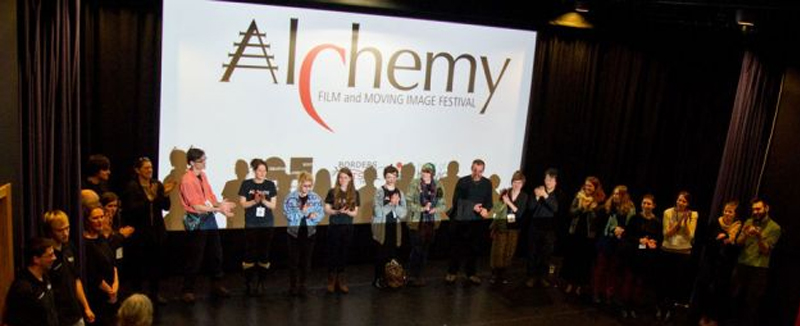
We were recently lucky enough to sit down and talk to Richard Ashrowan, Creative Director of the Alchemy Film and Moving Image Festival in Scotland, as well as being a moving image artist and film maker.
Tell us a bit about your job, and what you do before, during and after the festival?
I spend most of the year working on the festival – as soon as one festival finishes the planning and fundraising for the next one starts. I do the fundraising, put the festival team together each year, and take the primary role in reviewing all the submissions – we had 850 to go through this year, so this is quite an undertaking. I also handle the development of Alchemy Film & Arts as an organisation, invite the major filmmakers and guest curators, and curate a significant number of our screenings directly, by invitation. And budgeting, and much else besides. During the festival itself, I am closely involved with the screenings, handling most of the Q&A sessions.
When I am not organising the festival, I make my own films and sometimes I am lucky enough to have them screened at festivals. I also work on other projects, community filmmaking, exhibitions and screenings related to experimental film across Scotland, under the banner of Alchemy. So for me, experimental and artists’ film is a kind of total occupation and I feel very fortunate to be able to do this. That said, straight after the festival, I always spend at least a week working in the garden, grounding myself. Last year, my carrots won first prize at a local show. That was a special moment.
Wow, your sound like an extremely busy person, I don’t know how you manage to fit it all in!
What is the best and worst parts of your job?
The best part is meeting and talking with filmmakers, and those special luminous moments in an auditorium when a film is screened for the first time, there is something so magical happening at this moment between everyone present. I love to see creative activism, and in experimental film it feels very pure and unadulterated compared to some other art forms, and even some other forms of filmmaking. The worst part of the job is the amount of time I spend looking at spreadsheets, both financial and organisational. But nothing happens well without meticulous planning, so it’s worth it.
How do you think the festival has improved/changed since it first launched in 2010?
Alchemy Film and Moving Image Festival is now heading for its sixth edition. We’ll be showing 124 films from 26 countries across four days, including 13 Scottish productions, several international feature premieres, experimental shorts, video art, and live cinema performances. In our first year we had 33 film submissions, this year it was 850. Over the last few years, the festival has really grown in terms of its international profile, its influence and its audience, and now attracts UK premiere screenings from major international artists and filmmakers. Over 50 filmmakers will be visiting the festival this year. It is a non-competitive festival; there are no awards, and it is very much focussed on an in-depth exploratory experience of artists’ film. Our mission has grown more focussed and confident with every edition, and it is this strong and intense sense of focus, its deep and sincere commitment to filmmakers, that makes the festival stand out.
Do you have any favourite moments?
There was a moment, at the beginning of a Q&A with The Quay Brothers a couple of years ago, when we had to collectively shuffle our chairs forward to avoid the projector beam. It was kind of comical in the way it happened, and I felt, for a moment, that we had actually entered the distressed reality of one of their animations. I am not quite sure why I pick that moment… perhaps because Alchemy is quite a serious-minded festival, so maybe it is that – I like it when things break down into a kind of beautiful and profound absurdity every now and again.
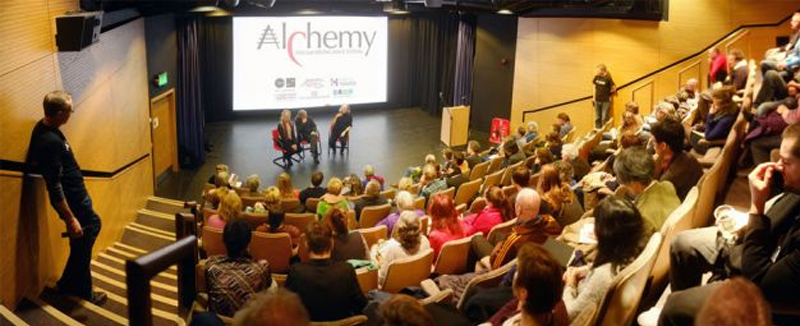
Can you describe what it is like putting on a film festival like this?
Basically it is intensely stressful, working long hours for months on end, and often in isolation – there is really no other way to describe it. Closer to the festival, this changes and it begins to be enormous fun, when the team comes together and everyone drives a shared vision forward together. But why do it? For me it is about creating a space for like minded filmmakers and artists to meet and experience one another’s work, creating the circumstances for a certain kind of magic to happen between them and their audiences. On a more personal note, one thing I notice, as I am an innately indecisive person, is that my own capacity for indecision is actually an asset in terms of curation. It necessitates a long-winded but deeply considered process of weighing up the pros and cons of every film, and how they might fit together. It ends up leapfrogging over rational thought processes. For indecisive people, this can be a kind of torture, but ultimately, I believe it creates a more finely tuned and intuitive experience for the audience.
How do you go about choosing a theme for each years festival?
It usually arises from conversations that happen at each festival. But in fact we’re thinking about dropping the yearly thematic element of the festival – in some ways the name of the festival itself – alchemy – is theme enough. What we want to do is to screen the very best of experimental and artists’ film, and not to be too narrowly limited by thematic considerations.
Do you have anything that influences you on your theme each year?
My own research interests have always been a big influence – my PhD thesis was on the use of light by alchemists, the historical metaphysics of light, and how all that might relate to experimental film practice. So I am drawn to languages of transformation of both an esoteric and material nature – several of our themes have arisen out of this – the four elements, dreamland, spiritus mundi, altered state. These are all alchemical, working with mixtures and experiments. The film festival itself is a kind of experiment in the arts of combination.
What do you look for when programming the festival?
Quite simply, I look firstly for images and ideas I have not seen before. I look for things that make me feel uneasy, things that challenge my capacity to understand or rationalise, which make me both feel and think. I am also impressed by work in which the presence of the author seems strong, when I feel there is some kind of truth to the creative process operating within the work. While I appreciate formal and process driven experimentation, this alone is never quite enough. The works that really stand out are those that manage to make their formal experimentation serve a broader intellectual concept, or which serve an emotional arc or inward exploration. I’m not so keen on very didactic work, and it is a sad truth that most submitted films, even when obviously ‘experimental’, obey quite formulaic structural and narrative patterns. The most important thing for filmmakers is to be free, to find a way of connecting directly and viscerally with their subject matter.
How do you think short film festivals help the industry?
The work our festival serves is not much connected to any recognisable industry, and I must admit I don’t much care for the film industry as such, nor the art industry either. My only interest in it is in how the industry (of festivals, exhibitors, distributors etc.) can serve the creative intentionality of individual artists and filmmakers. Where the industry can support creative activism, I am all for it. Yet my experience of most forces within the industry, of both art and film, are of a deep and unimaginative conservatism, riddled with power structures and professionals jostling for status. I somehow prefer to adopt a stance linked more to childlike curiosity, wonder, and a kind of conscious amateurism.
Is there anything you are looking forward to at this year’s festival?
The thing I most look forward to is the intense meeting of minds that happens during the festival – it is a very discursive and intense experience. I like to think there is something almost magical here – it is the great mystery of alchemy itself – the not knowing what kind of volatility might arise through the mixing of disparate elements. In terms of the programme itself, our Filmmaking Symposium this year has a truly stellar panel of speakers: some the leading figures involved in artists film from around the world. I honestly don’t think such a high powered panel has ever been seen in Scotland before. I also would’t miss the World premiere of Allan Brown’s Silver, nor the UK premiere’s of features by Nina Danino and Caspar Stracke. Jacques’ Perconte’s Ettrick is a major event for us, made in the Scottish Borders and fresh from its USA premiere at MoMa in New York. And then performances from Gaelle Rouard (France) and Monteith McCollum (USA), our installations and shorts programmes…. it is simply impossible to choose one thing over another.
What advice would you give someone who was thinking about submitting a film to the festival?
I have four bits of advice… firstly, make your film as short as you possibly can, then shorten it again by a third. Almost every film I see could be shortened by a third and would just be better for it. Too many people are now making feature length works that claim to be durational, but which are in fact just a bit too boring. Secondly, there is almost no circumstance within a film when tinkly piano or whooshing strings make an acceptable soundtrack. Thirdly, avoid digital filters entirely, especially the mirror effect (much overused in many submissions in 2016) – if you want to make a visual effect, make it happen outside the camera – it will be much more interesting. Fourthly, take proper time to understand the competitive context you are in by visiting as many film festivals as you can, and then ask tough questions of yourself in terms of your own work.
In your opinion what is it that is so special about short film?
Short film is special because anyone can make it, without a crew, without expensive gear, and without a budget. This makes it possible to make a real, personally meaningful and truthful creative statement. What else is there to aspire to?
Thanks Richard it has been great speaking with you.
You can find out more information about the upcoming 2016 Alchemy Film and Moving Image Festival here.