

Alchemy of the Spirit (2022) Film Review
In Alchemy of the Spirit, death is interpreted as it hasn’t been in many films. It’s a film that addresses the necessary conversation through a poetic and very dramatic overview of a man who can’t fathom the fact that someone close has passed. However, in Steve Balderson’s film, reaction to the inevitable is transformed into a journey that goes beyond our initial conception of grief.
Surely, if your loved one dies, you know what to expect. At least, the basic acts.
Fortunately, there’s nothing traditional about Balderson’s Alchemy of the Spirit. From Xander Berkeley’s beautiful performance to the magical realism that floods every frame and the script itself. It’s a very weird and atypical depiction of grief. But it doesn’t mean it isn’t understandable.
The film begins when Oliver Black wakes up next to his wife and he realizes she’s dead. Struck by the unexpected, the man can’t seem to awake from the nightmare. His immediate reaction is to preserve her body and make a death mask of her face. At the same time, his agent calls and asks Oliver to work on the next big thing: an art collection for a big museum.
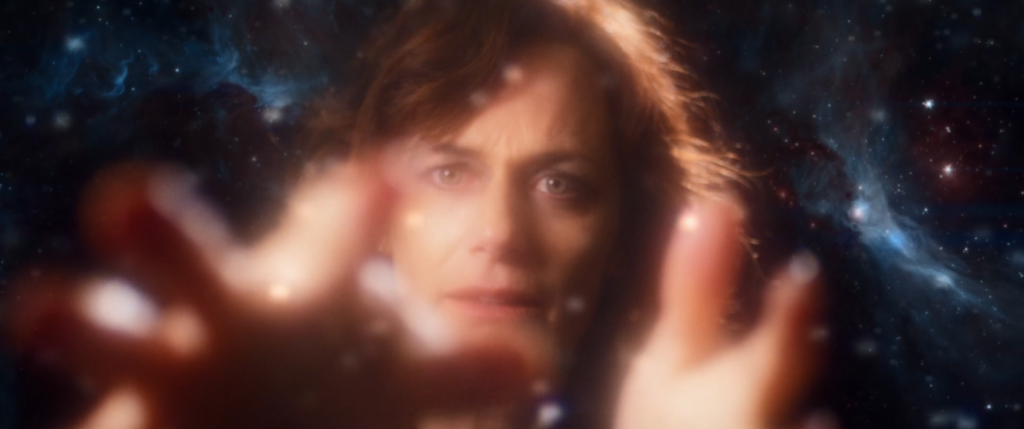
Oliver’s obsession of recreating Evelyn’s face has a result. She appears next to Oliver and she’s got a message. He can’t understand if she’s alive or dead. If she’s actually there or if he’s hallucinating. He goes down the rabbit hole with a fully woke Evelyn who brings a message.
Alchemy of the Spirit is an experiment about suspension of disbelief in a dramatic setting that’s entirely dominated by the performance of Berkeley and its relation with the genres Balderson approaches in the film. At times, it feels like a horror film. But right after that, there is nothing but uncorrupted love on the screen. The chemistry between Berkeley and Sarah Clarke is tangible and effective.
Nevertheless, Alchemy of the Spirit is traditional when it has to be. When it needs to communicate the reasons behind Oliver’s flawed and humane acts of desperation. Balderson allows for us to see what’s behind the mysterious imagery and the many possibilities to the story. The cosmic representations were scarce, but it would have been very interesting to know the story behind those.
Films don’t have to tell the same stories we’re familiar with. Comfort zones aren’t always better. And filmmakers like Balderson open the windows into passages that show the many sides of existentialism through a traumatic, yet romantic storyline. He proves it’s possible to inject some original material into the typical, and makes something worth talking about.
Oh, and composer Heather Schmidt’s score is just fantastic. It’s sharp and precise for the film’s multiple personalities. I would love to hear more of her!


