

Movie Review: 2001: A Space Odyssey (1968)
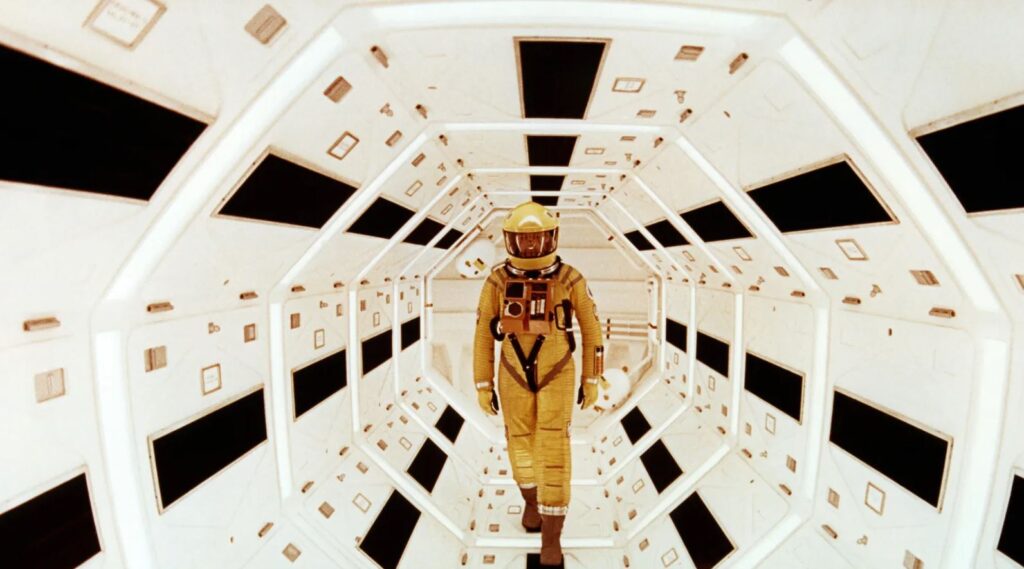
In 1968, a science fiction film sharply polarized its viewers: a little feature called “2001: A Space Odyssey.”
Think of all the platitudes a movie can receive: ambitious, thought-provoking, dull, artistic, morally wrong.
This film garnered all of them, and more. If there’s ever one thing a great movie usually is, it is that it’s always going to court controversy. Fast-forward to 2021: The balance of the reception for that same film has greatly tilted toward the positive.
And for good reason.
“2001: A Space Odyssey,” the great Stanley Kubrick‘s chef d’oeuvre, is a love letter to mankind’s search for reason of its existence, as well as its place in the vast universe. Featuring themes of existentialism and artificial intelligence, with the use of advanced special and practical effects, this is one of the boldest—and best films—I have ever seen in my life.
Mankind’s Search for Meaning in Galaxies Far, Far Away
Co-written by Kubrick and science fiction writer Arthur C. Clarke, ‘2001’ was inspired by Clarke’s series of short stories, the most prominent of which being his 1951 short story “The Sentinel.” The film follows an alien monolith appearing in an African veldt during the prehistoric time, influencing a hominid to use a bone as a weapon and tool. Thus, civilization was born.
Millions of years later, scientists discover a similar monolith buried on the moon. And 18 months after, another monolith is discovered on Jupiter, prompting the United States to send a spacecraft to study it. In this mission to Jupiter, we see Dr. David Bowman (Keir Dullea) and Dr. Frank Poole (Gary Lockwood) heading the team. Also, we see HAL 9000 (voiced by Douglas Rain), a computer with a human personality to assist with the operations. As the team carries on, we get to see existential themes play out, and Kubrick executes them to surgical perfection.
Here Be [Intended] Confusions, Dear Moviegoer
Kubrick does a juggling act in the film to tackle themes of human evolution, technology, and artificial intelligence. In addition, ‘2001’ posits the possibility of extraterrestrial life, something that fascinated the general public at the time of the film’s release.
But with it come the really interesting side notes. I mean, imagine a film so good and pioneering, that it actually prompted conspiracy theorists to question the authenticity of the moon landings. Specifically, some have accused the US government of hiring Kubrick to direct fake footage of Neil Armstrong and Co. walking on the moon.
Anyway, I digress: ‘2001’ is the perfect answer as to why I love going to the movies. A subject as broad as an ever-expanding universe needs more than one viewing to understand how it works, and ‘2001’ has given its audience that task. While the first viewing is for the visual experience of it all, subsequent viewings are encouraged for more existential and metaphysical questions to answer.
Similarly, Kubrick and co-writer Clarke aimed that the movie resonated with its audiences for different reasons. What’s more is that these men were both firm in saying that if audiences understood the movie’s messages on first viewing, it meant that they both failed in their objectives.
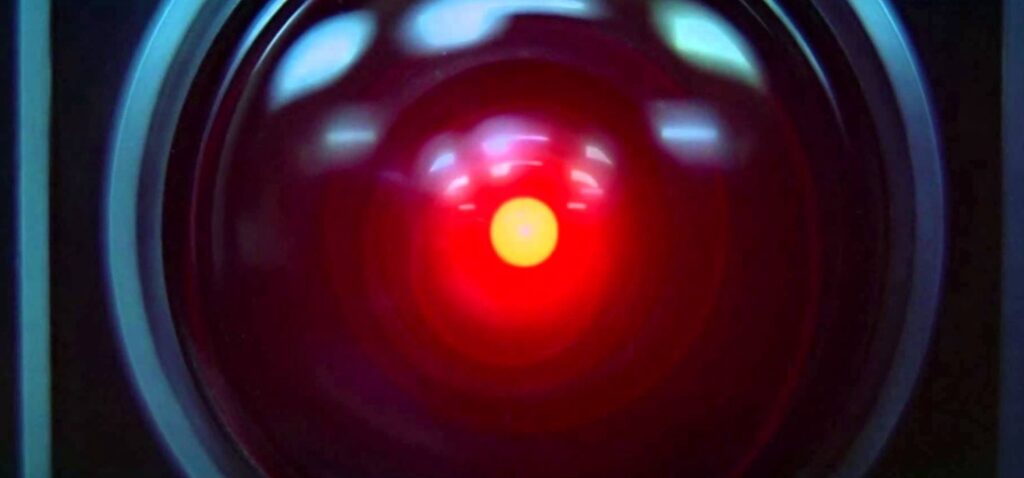
A Space Odyssey That Asks Questions—and Doesn’t Want Answers in Return
Good science fiction films are those that can move us to ask questions once the credits start to roll. These films stimulate our minds and start conversations even outside the theater.
Great science fiction movies, on the other hand, are those that are content to ask a singular question to their viewers, and have them come up with a thousand different answers while the films are still playing. These movies have the guts to predict how the future can look like regardless of how ridiculous they sounded at the time; only to be proven later on to be close to the real thing.
‘2001’ belongs to this pantheon; and Skype and Apple can thank this movie for giving them ideas.
Conversely, some may hate the slow pace as well as the open-ended, unanswered third act; but that’s exactly the auteur’s intent. ‘2001’ dares us to ask but deliberately withholds the answer; with Kubrick believing that to give concrete answers to the movie’s questions would be akin to da Vinci explaining that Mona Lisa was smiling that way because she had rotten teeth.
2001 Ways to Copy a Keeper
Over the years, several other motion pictures have used this film as template. “Interstellar,” “Artificial Intelligence,” and “Contact” come to mind right away. However, none of them have come close to this mankind’s epic journey toward the discoveries in front of him; whether it’s as simple as his use of bones as tools for everyday life, or as complicated as going to a dimension where time is non-linear and he can see different versions of himself. Few films possess that audacity to trust in their audience to keep up with the questions and themes presented onscreen.
‘2001’ is at the forefront of that small band.
“2001: A Space Odyssey” is, for better or worse, Stanley Kubrick’s ode not only to cinema but also to humanity. As terrific as it was 50-plus years ago, this film has solidified its reputation as a timeless work of art. This is an epic masterpiece that dares its audience to challenge their own perception of mortality; all the while straddling them for a cosmic, vortex-bound interstellar ride that’s equally breathtaking and terrifying.
From its awe-inspiring introduction to its memorable villain, not only does “2001: A Space Odyssey” stand as the best science fiction movie ever put into celluloid.
Hands down, it’s also one of the greatest films of all time.


